Bulldog Harnesses: A Fit-First Walking Guide (2026)
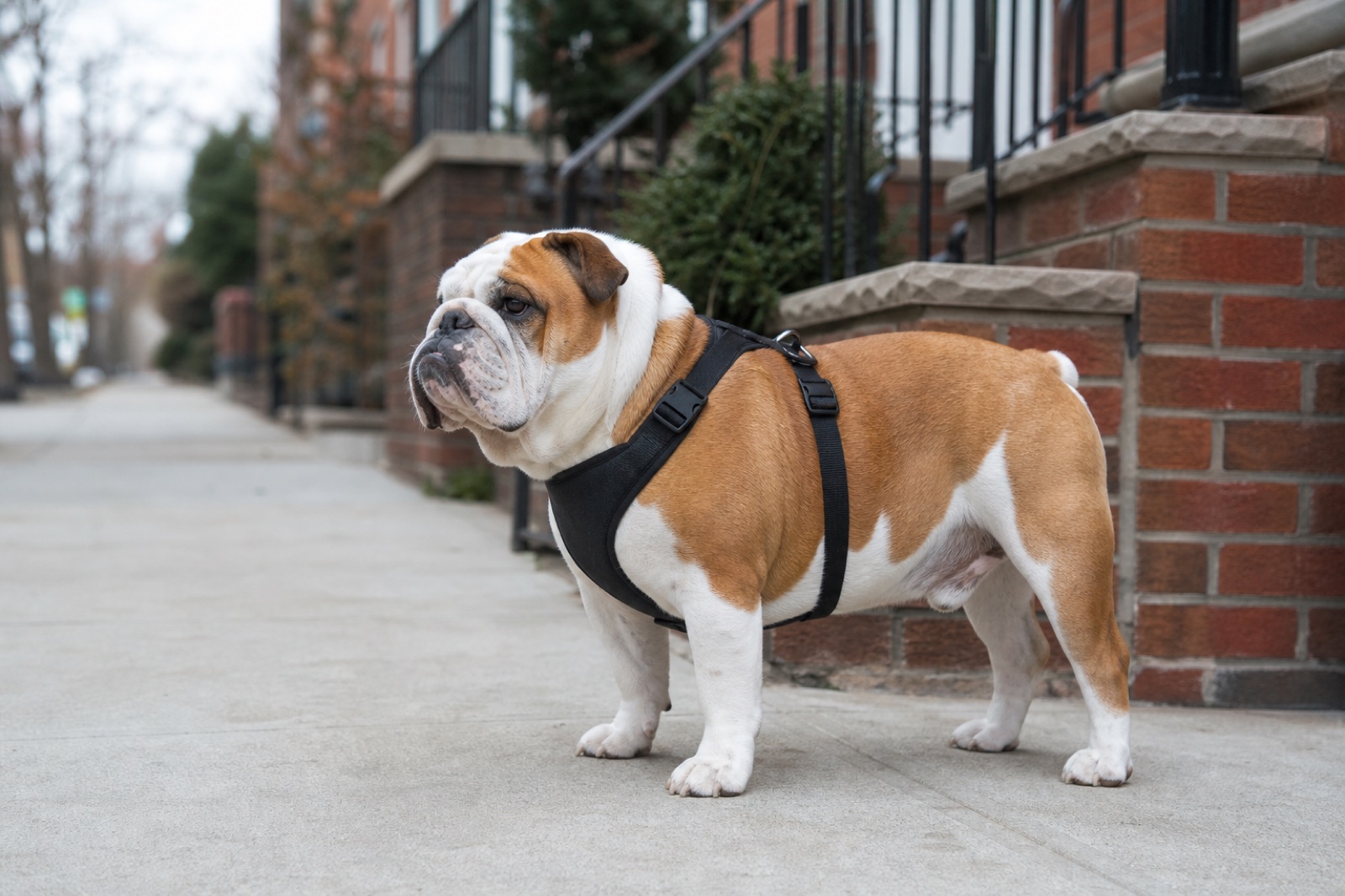
Harness measurement checklist
- Chest girth: widest point of the ribcage, typically a hand’s width behind the front legs. Record the number the size chart asks for.
- Lower neck / throat: only if the chart requires it; keep the tape snug but not compressing the airway.
- Body length / panel proportion: withers to base of tail (or brand’s stated points) so the back panel can centre without sliding onto the neck or hips.
- Indoor fit test: walk, turn, sit, and sniff. Reject any harness that folds, rides up the throat, or lets the dog reverse out.
Use the brand chart that matches this product family; recheck after body-condition changes.
Related: How to measure a dog for a harness · Harness fit by body type.
A harness is not automatically better simply because it has more straps or padding. For a Bulldog, the useful one sits securely around the body, leaves the front legs and shoulders free to move, and gives the handler a predictable connection point. Harness choice does not replace training or veterinary guidance. If your dog coughs, seems distressed, pulls abruptly, or changes their movement, stop and get appropriate professional advice.
Begin at the chest, not the neck
Measure the widest part of the ribcage, a hand’s width behind the front legs, while the dog is standing. Then measure the lower neck area specified by the manufacturer; this is not the same as a collar size. Use the brand’s actual chart and check its adjustment range. A broad-chested dog can fall outside generic size assumptions, so a label such as “large” tells you very little.
Put the harness on indoors without attaching a leash. The back panel and clip should sit centred over the spine. The front section should lie across the chest rather than press against the throat. The straps behind the front legs need enough space to avoid rubbing but not so much slack that the dog can reverse out. The familiar two-finger check is only a starting point: watch the harness while the dog walks, turns, lowers their head, and sits.
| Walking purpose | Harness feature to compare | Test it by |
|---|---|---|
| Ordinary local walks | Back clip and several adjustments | Checking it remains centred after ten minutes |
| Pulling practice | Front and back attachment options | Using it with a trainer’s plan, not as a quick fix |
| Escape-conscious dog | Extra body adjustment | Confirming it still clears shoulder movement |
| Car connection | Manufacturer-approved restraint system | Following vehicle system instructions, not using a walking harness by default |
Read the pattern, not just the padding
An open, Y-shaped front pattern often leaves more room around the shoulder area than a broad horizontal chest strap, but every individual fit still needs testing. Thick padding can conceal a poor pattern and hold heat. Prioritize smooth edges, protected hardware, sturdy webbing, and adjusters that do not slip after use.
Check whether the leash point is placed where the harness stays balanced. A clip pulled far to one side will rotate the whole assembly. If you use a front attachment for a training plan, attach it only as the product intends and keep sessions short enough to observe movement. Do not attach a leash to a decorative ring or carry handle unless the maker explicitly rates it for that use.
Fit, monitor, and maintain
The first walk should be local and calm. Recheck all straps after several minutes, then examine the chest, armpit area, and coat after removal. Redness, hair loss, pinching, a changed gait, or repeated scratching mean the harness needs adjustment or replacement. Do not leave a harness on indoors or unattended; it can catch on furniture and it is harder to notice a rub point.
Hand wash or follow the label’s instructions, rinse grit from buckles, and inspect stitching and adjusters every few weeks. Replace a harness with cracked hardware, frayed load-bearing webbing, or adjustment points that will not hold. A second harness can be useful while the first dries.
Bulldog harness checklist
- Measure the widest chest and the maker’s specified lower-neck point.
- Centre the back panel; keep the front section on the chest, not the throat.
- Check shoulder reach, turning, sitting, and head-down movement.
- Match the attachment setup to a clear walking purpose.
- Remove after walks and inspect fit points, webbing, and hardware.
The correct Bulldog harness is the one that remains stable through normal movement and is fitted to the individual dog, not to a breed stereotype.
Record the successful settings
Once the harness stays centred on several short walks, take a photo from above and note the adjustment positions. That gives you a reference after washing, sharing the dog with another handler, or making a seasonal coat adjustment. Recheck after any notable change in body condition or if the harness starts rotating. Do not mark webbing with an abrasive pen that could weaken fibres; a phone photo is enough. A repeatable fitting routine is more dependable than continually tightening straps by feel.
When comparing two otherwise suitable models, select the one you can put on without wrestling the dog or obscuring the fit points. A difficult buckle routine causes rushed checks, and rushed checks create avoidable errors.
About the Reviewer
Our editorial team researches breed-related needs, compares product specifications, and updates guides as information changes. Product gear does not replace veterinary advice. Read our editorial process.